 kinto creativeKinto Creative
Work with us
If you run an independent gym, it is easy to assume the big chains own Google. They have the budgets, the brand names and the hundreds of reviews. So on 28 October 2026 we looked at who actually turns up in the map results when someone searches “gym” on their phone in 20 UK towns.
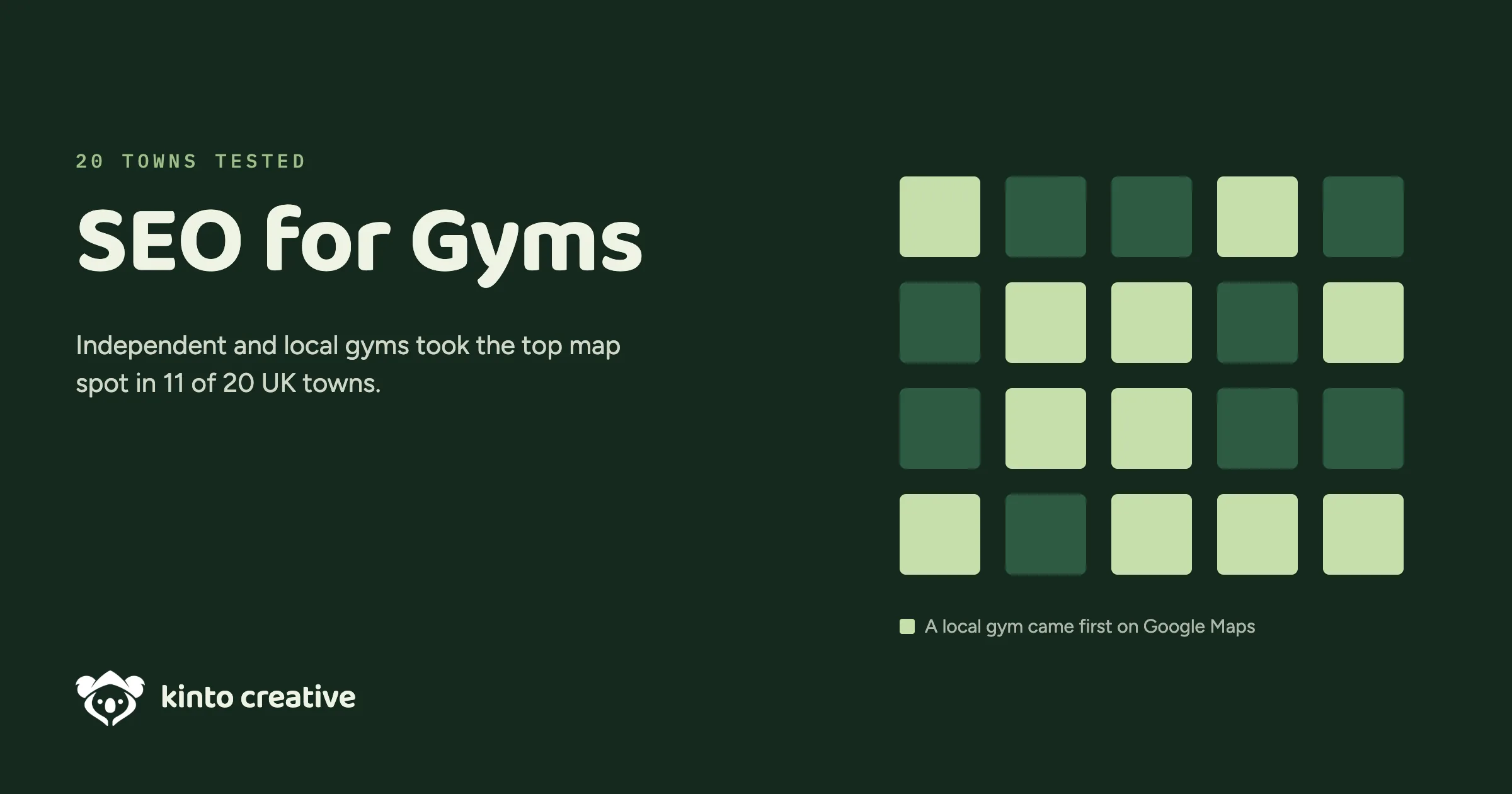
The chains took half the spots. Independent and local gyms took the other half, and they were in first place in 11 of the 20 towns.
We ran one search, “gym”, as it appears on a phone in each of 20 towns: Aberdeen, Brighton, Bristol, Cambridge, Cardiff, Chelmsford, Cheltenham, Chester, Exeter, Guildford, Ipswich, Lincoln, Norwich, Oxford, Plymouth, Reading, Shrewsbury, Swindon, Worcester and York. For each town we recorded the three gyms in Google’s map results, with their rating and review count. That gave us 60 spots.
Then we sorted each gym into one of three groups. National chains and franchises are the brands you would recognise anywhere in the UK, such as PureGym, The Gym Group and Anytime Fitness. Local groups run more than one gym but are not national, which we checked on each gym’s own website. Independents run a single gym. Finally, we checked the websites of the 30 gyms that were not national chains. There is more detail on the method at the end.
Half of the 60 spots went to national chains. The Gym Group appeared seven times, Anytime Fitness and JD Gyms five times each and PureGym four times. That still left the other half for local gyms, and they did well at the very top. Independents were first in six towns and local groups in five, so a non-chain gym led the map in 11 of the 20.
In 17 of the 20 towns, at least one gym in the top three was not a national chain. Only Chester, Reading and Swindon were chains all the way down.
That fits what Google says about its own local results, which it describes as “mainly based on relevance, distance, and popularity” (Google Business Profile Help). A national marketing budget doesn’t move a gym closer to the person searching, and it doesn’t write the reviews.
The chains had more reviews. Their median in the top three was 274, against about 117 for the independents. But the independents had the better average rating: 4.7 against 4.5.
You don’t need hundreds of reviews to get into the top three. The smallest independent in our data had 28 reviews, averaging a full five stars. The top gym in Plymouth had 29, averaging 4.9.
Google says that “more reviews and positive ratings can help your business’s local ranking”. What helps most is a steady routine: ask the members who are clearly happy, at the moment they are happy, and make it one tap with your review link or a QR code at the front desk. We have seen how quickly that adds up for a one-person fitness business. When we started working with Yerby Coaching in July, her Google profile had 4 reviews. By October it had 26, all five stars, and she was in the top three on the map for “personal trainer Kilburn”.
The clearest sign of this was in Plymouth, where the first gym on the map doesn’t link to a website at all. Its Google listing links to a Facebook page. It is there on the strength of its listing, its location and its reviews.
That doesn’t make the website pointless. It’s where someone can check your prices and look round before they join, and it’s what ranks in the ordinary results below the map. But if you only have time to work on one thing, start with the listing. For a gym, that means:
This one comes from our own work rather than the study. Two of the gyms we spoke to this year had more than one Google listing for the same building, and in one case two listings shared the same address and phone number. Google’s guidelines are clear that “there should only be one profile per business” (Google Business Profile guidelines). A duplicate also splits your reviews across two listings. Search your gym’s name on Google Maps, and if a second listing turns up, ask Google to remove the duplicate through Business Profile support.
The bigger risk is to the listing you actually want. In our experience, a gym with a second profile risks having it suspended, and its main profile flagged along with it. It’s much easier to sort out before that happens than after.
We checked the websites of the 30 gyms that were not national chains. One links to Facebook, and two listings for the same local group sent people to the same homepage, which left 28 different websites. For each one we looked at the homepage, plus a prices page and a timetable page where they existed.
| What we looked for | Sites |
|---|---|
| Prices shown, on the homepage or a prices page | 24 of 28 |
| The town in the page title | 21 of 28 |
| A meta description | 21 of 28 |
| Opening hours or times written on the page | 16 of 28 |
| A tap-to-call phone link on the homepage | 12 of 28 |
| Local business details, with an address, in the page code | 6 of 28 |
There is good news here: 24 of the 28 show their prices. Three things stood out as easy to fix.
Tap-to-call. Sixteen of the 28 homepages had no phone link you can tap. Someone who found you on the map is on their phone, and the easiest enquiry you will ever get is a call they can make with one tap.
Location details in the code. Only 6 of the 28 sites told Google their address, hours and phone number in the structured data behind the page. There is a type made for exactly this, ExerciseGym, and it takes a few lines of code. It was the most common gap in our audit of 70 UK fitness websites too, where 57% of multi-site studios and clinics had none.
One page per gym. One local group had two gyms in the map results, in two different cities. Both listings sent people to the same homepage, and its page title didn’t name either town. If you have more than one gym, each one deserves its own page with its own address, hours, photos and directions, and each Google listing should link to it.
If you only fix one thing this month, make it the first: check your main Google category is right. The local SEO specialists surveyed for Whitespark’s 2026 Local Search Ranking Factors rank the primary category as the biggest single factor for showing up in the map results, just ahead of how close you are to the person searching.
Can an independent gym outrank PureGym or The Gym Group on Google Maps?
Yes. In our check of 20 UK towns, an independent or local gym was the first map result in 11, and in 17 towns at least one of the top three was not a national chain.
How many Google reviews does a gym need?
There is no fixed number. The independents in our data had a median of about 117, and the smallest had 28 at an average of five stars. Your rating and a steady flow of new reviews matter as much as the total.
Does a gym need a website to show up on Google Maps?
Not to show up. The first map result in Plymouth links to a Facebook page. But a website is where people can check your prices and look round before joining, and it’s what ranks in the results below the map.
What is ExerciseGym schema?
It is a type of structured data from schema.org, described simply as “a gym”. It is a kind of local business, so you can use it to tell Google your address, opening hours and phone number in a form it doesn’t have to guess at.
On 28 October 2026 we pulled Google’s live results for the search “gym” through DataForSEO, set to a mobile phone and located in each of the 20 towns. We recorded the three gyms in the map results for each town, with their rating and review count as Google showed them.
We counted 13 brands as national chains or franchises: PureGym, The Gym Group, Anytime Fitness, Snap Fitness, JD Gyms, Energie Fitness, Everlast Gyms, Simply Gym, Total Fitness, Village Gym, 24/7 Fitness, Buzz Gym and BFT. For every other gym, we checked its own website to see whether it runs one site or several.
The website checks used public pages only, as any visitor would see them: the homepage, plus a prices page and a timetable page where the homepage linked to one. We checked that every site gave us enough readable text to judge.
This is a snapshot. Map results shift with exactly where someone is standing and when they search, and one search term in 20 towns is a sample, not a census. We haven’t named the gyms, because this isn’t a ranking of the best gyms in the UK. It’s a look at what the ones Google already favours have in common.
Want your gym in those three spots?
Our Visibility Setup is £500 alongside a website build, or £697 on its own, paid once rather than monthly. We build out your Google listing, get you listed across 20+ quality directories and hand you a report showing exactly where you started.
See our Local SEO →