 kinto creativeKinto Creative
Work with us
Last month we looked at who Google puts on the map when someone searches “gym” on their phone in 20 UK towns, and the national chains held half the spots. On 12 November 2026 we ran the same check for “pilates” and “yoga” in the same 20 towns. This time we also looked at the businesses that missed out, so we could see what the studios on the map had that the others didn’t.
Franchises barely featured. The studios that made the map had a few things in common, and most of them are on your Google listing, which you can check today.
We searched “pilates” and “yoga” as they appear on a phone in the same 20 towns as our gym study: Aberdeen, Brighton, Bristol, Cambridge, Cardiff, Chelmsford, Cheltenham, Chester, Exeter, Guildford, Ipswich, Lincoln, Norwich, Oxford, Plymouth, Reading, Shrewsbury, Swindon, Worcester and York. Google showed two or three studios in the map box in each town. That gave us 43 spots for Pilates and 54 for yoga.
Then we pulled Google Maps’ own results for the same searches in the same towns, and took every business in its top 10 that hadn’t made the map box: 332 in all. For both groups we looked at the Google listing (main category, name, reviews and phone number) and at the website it links to. There is more on the method at the end.
Not sure where you currently come up? We’ll check it for you, free.
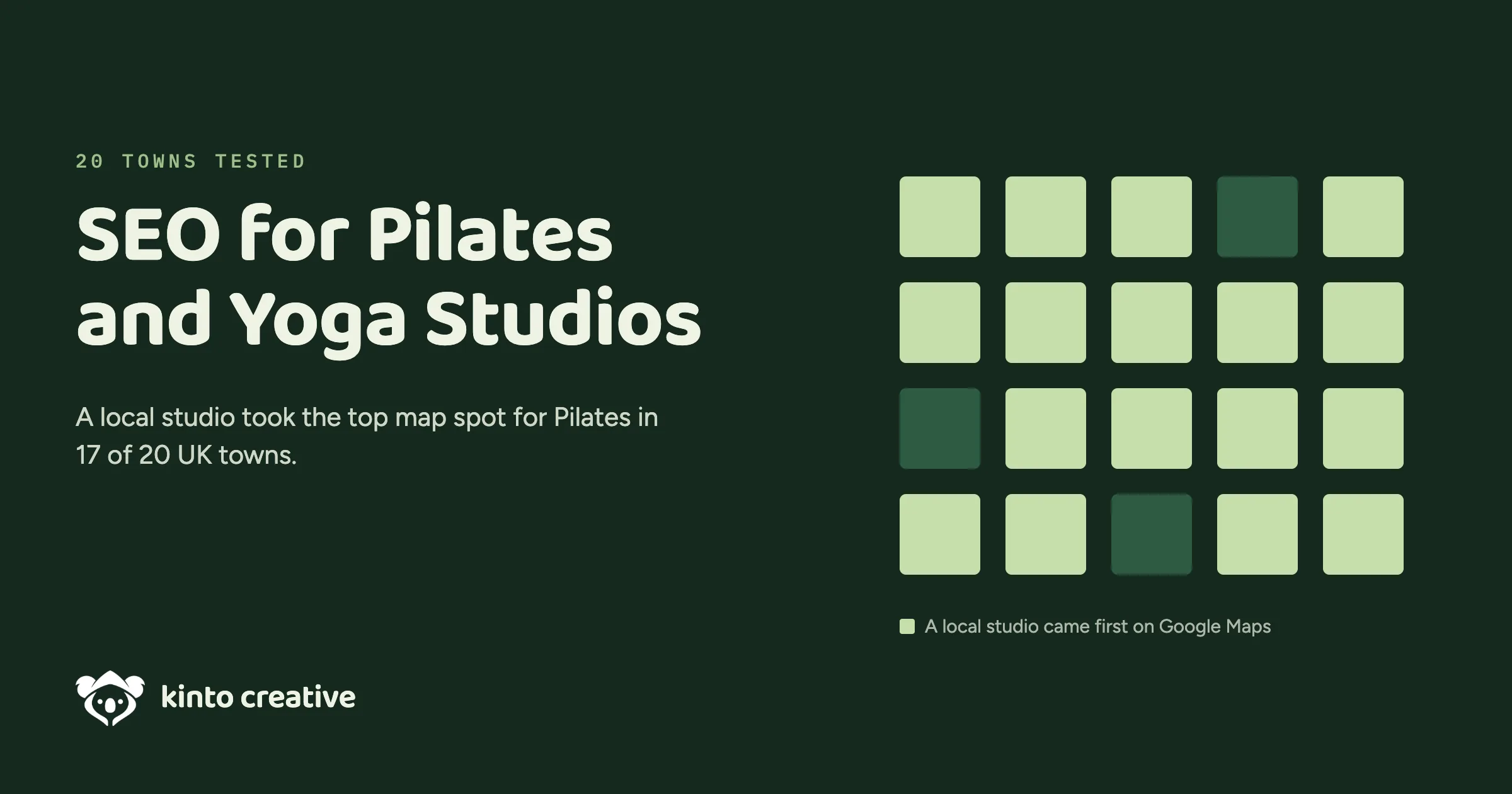
Three of the 43 Pilates spots went to franchises: Studio Pilates International twice and STRONG Pilates once. For yoga, Hotpod Yoga took 6 of the 54. Everything else went to studios run locally. Most are single studios. A few are groups, from two studios in one city up to one with studios in nine towns across the north of England and the Midlands.
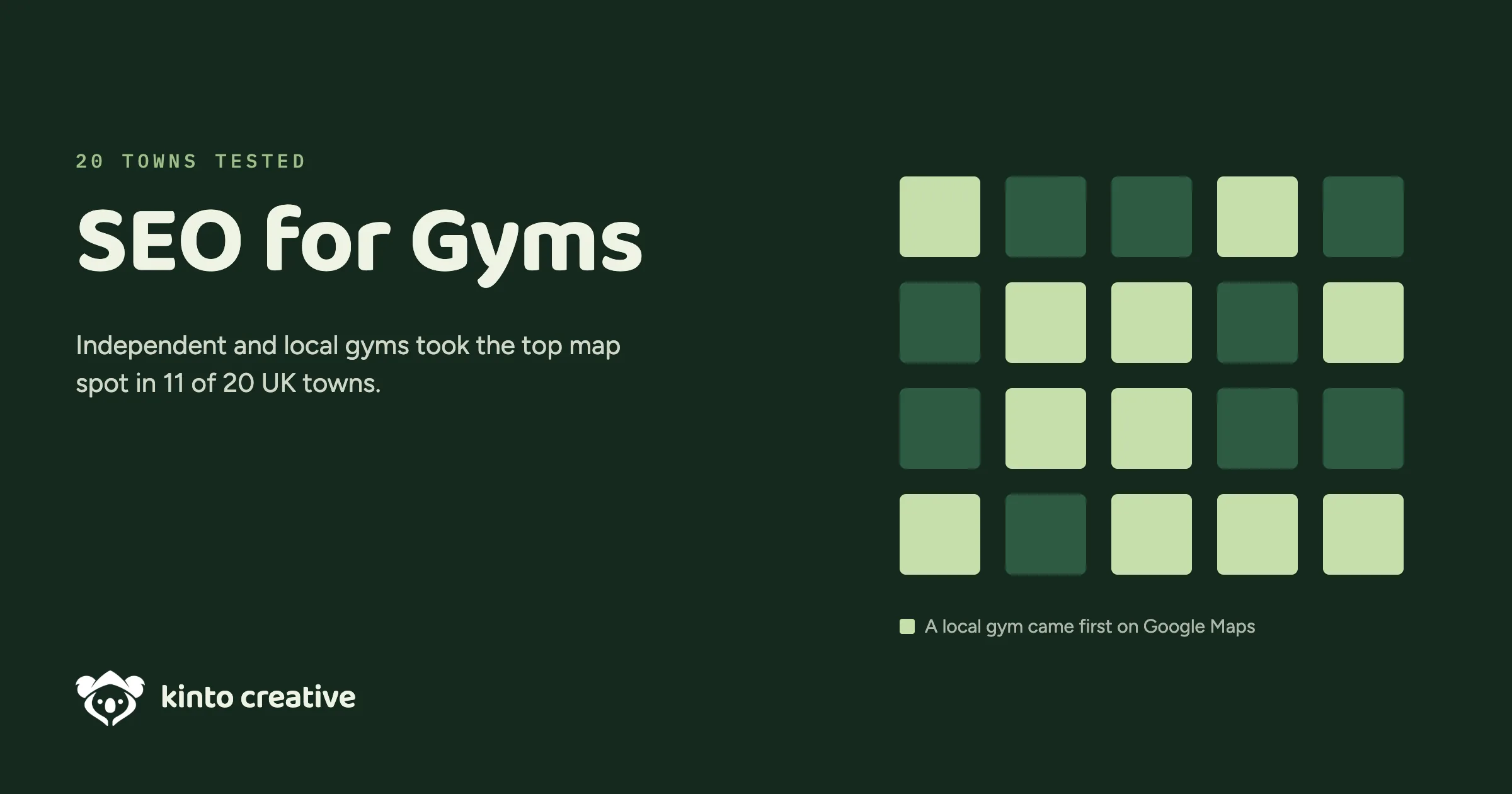
Where a franchise was on the map, it often led. All three Pilates franchise spots were in first place, in Bristol, Exeter and Oxford, and Hotpod was first for yoga in Bristol and Chelmsford. That still left a local studio in first place in 17 of the 20 towns for Pilates and 18 of the 20 for yoga. For gyms, national chains held 30 of the 60 spots and were first in 9 towns (our gym study has the detail).
The chart compares the 97 map spots with the 332 businesses that missed out. The first two rows are where the gap was. The last four barely moved, and we come back to those below.
This was the biggest gap. In 83 of the 89 map spots where we could see the category, the studio had “Pilates studio” or “Yoga studio” as its main category, matching the search. Among the businesses that missed out, it was under half.
Many of those are gyms, fitness centres, personal trainers, individual yoga teachers and dance schools that offer Pilates or yoga alongside something else, so they were never going to be listed as a studio. Others are studios listed under the other discipline, such as a yoga studio showing up in a search for “pilates”. And some are Pilates studios that chose a different category. Of the 78 businesses with “Pilates” or “reformer” in their name that missed the Pilates map, 12 had a main category other than “Pilates studio”, such as Gym or Personal trainer.
Google asks businesses to “choose categories that are as specific as possible, but representative of your main business” (Google Business Profile guidelines). If you run a Pilates studio, that means “Pilates studio” as your main category. It was also the first fix on the list in our gym study.
76% of the studios on the map had “Pilates”, “reformer” or “yoga” in their name, against 41% of the ones that missed out.
That is not a reason to add words to the name on your Google listing. Google’s guidelines say “your name should reflect your business’s real-world name” and that “including unnecessary information in your business name isn’t permitted”. It’s worth knowing if you are naming a new studio.
Studios on the map had a median of 53 Google reviews. The businesses that missed out had 21. Google says “more reviews and positive ratings can help your business’s local ranking” (Google Business Profile Help), and the gap fits that.
But reviews didn’t decide the order within the map box. In 10 of the 20 towns for Pilates, and 11 of the 20 for yoga, the first studio had fewer reviews than one listed below it. One Pilates studio was first in its town with five reviews.
Ratings didn’t separate them either. 41 of the 43 Pilates spots went to studios rated 4.9 or 5.0, so on the map a near-perfect rating is normal. What helps is a steady routine: ask clients after a class they clearly enjoyed, and send them your review link so it takes one tap.
The bottom four rows of the chart are things we expected to separate the two groups, and the gaps were small. A website on the Google listing: 98% on the map against 93% that missed out. The town in the homepage title: 64% against 56%. Local business details in the page code: 34% against 35%. The same phone number on Google and the website came out at 84% against 73%, the biggest gap of the four, but still small enough with these numbers that it could be chance.
None of this means your website doesn’t matter. It’s where someone checks your timetable and prices before they book, and it’s what ranks in the ordinary results under the map. But the differences we found between the two groups were on the Google listing, not the website. Two studios on the map had no website on their listing at all, and a third linked to its page on a booking platform.
Google Maps isn’t the only place people look for a studio. On 12 November 2026 we asked ChatGPT, twice, for a Pilates instructor in Ealing. Both times it recommended Liz Shaw of Shaw Lifestyle, a personal trainer and Pilates coach we work with. She came second once and third once. The second time, the link it gave for her was her Google Maps listing. Both times it gave her mobile number, which is the same number on her website and on her Google listing.
From working on Liz’s site, our view is that it comes down to consistency across everywhere she’s visible online: her website, her Google profile and her social media.
Our map data doesn’t prove that for Google Maps, where the phone numbers also matched for most of the businesses that missed out. ChatGPT works differently, and in Liz’s case the details it gave matched what she publishes everywhere else. To check your own, ask ChatGPT for a Pilates or yoga studio in your area, see whether you come up, and check that what it says about you matches your website and your Google listing.
If you only do one, make it the first. The local SEO specialists surveyed for Whitespark’s 2026 Local Search Ranking Factors rank the primary category as the biggest single factor for showing up in the map results, and it was the biggest gap in our data too.
Can a small Pilates studio beat a franchise on Google Maps?
Yes. In our check of 20 UK towns, franchises held 3 of the 43 map spots for “pilates”, and a local studio was the first result in 17 of the 20 towns.
What Google category should a Pilates studio use?
“Pilates studio”, if that is your main business. In 83 of the 89 map spots where we could see the category, the studio used “Pilates studio” or “Yoga studio” to match the search, against under half of the businesses that missed out.
How many Google reviews does a yoga studio need?
There is no fixed number. Studios on the map had a median of 53, against 21 for the businesses that missed out, but in about half the towns the first studio had fewer reviews than one listed below it.
Does schema help a studio show up on Google Maps?
Not in our data. 34% of the studio websites on the map had local business details in the page code, against 35% of the businesses that missed out.
On 12 November 2026 we pulled Google’s live results for “pilates” and “yoga” through DataForSEO, set to a mobile phone and located in each of the 20 towns. We recorded every studio in the map box with its rating, review count and phone number as Google showed them. We counted Studio Pilates International, STRONG Pilates and Hotpod Yoga as franchises, and looked at the websites of studios that appeared to run more than one site.
For the comparison, we pulled Google Maps’ top 20 for the same searches and towns, and took the businesses in its top 10 that weren’t in the map box. A business that appeared in both the Pilates and the yoga results counts once for each, and so does a studio in both map boxes. Main categories come from Google Maps. For every website we checked the homepage and the first contact page it linked to, using public pages only, as any visitor would see them.
The ChatGPT check used the same question twice, with web search on and the location set to the UK.
This is a snapshot. Map results shift with where someone is standing and when they search, and two searches in 20 towns is a sample, not a census. We haven’t named the studios, because this isn’t a ranking of the best studios in the UK. It’s a look at what the ones Google already shows have in common.
Want your studio on that map?
Our Visibility Setup is £500 alongside a website build, or £697 on its own, paid once rather than monthly. We build out your Google listing, get you listed across 20+ quality directories and hand you a report showing exactly where you started.
See our Local SEO →You’ve just read what it takes for Pilates and yoga studios to get found locally. Want to know where you actually come up? Tell us what you do and the town you want to be found in. We’ll run your Google map pack properly and send back what comes up. Free, and it takes us about five minutes.